


Telehealth vs In-Patient Care: Which Is Better for Today’s Patients?
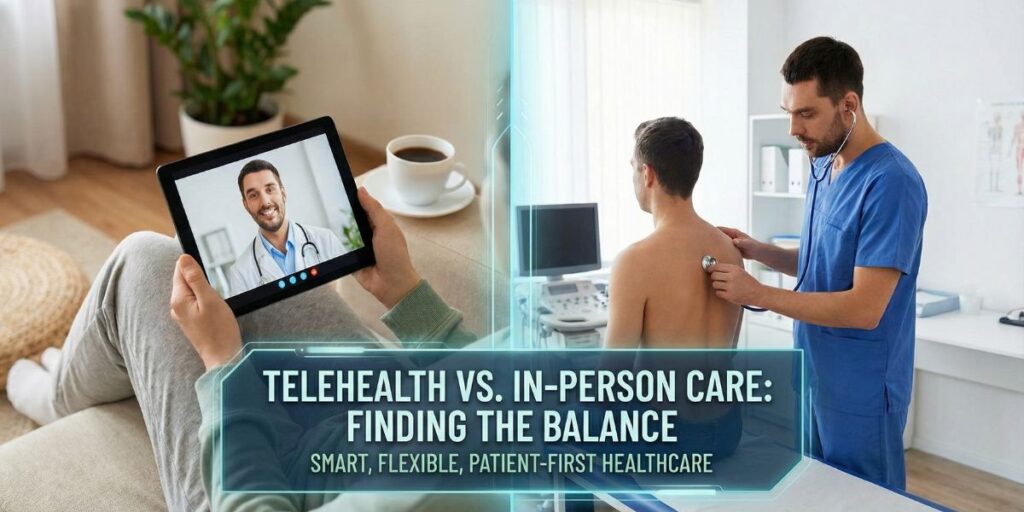
The healthcare world is changing faster than ever. What once required a clinic visit can now be handled through your phone, while certain health situations still demand face-to-face care. This shift has created a big question for patients and doctors alike:
Is telehealth better, or is in-patient (in-person) care still the superior choice?
The answer isn’t as simple as picking one over the other.
Both have strengths, both have limitations — and the right choice depends on the patient’s condition, the complexity of care needed, and the level of convenience required.
In this blog, we explore the two models in detail so patients and providers can make smarter, more confident decisions.
Understanding Telehealth: Healthcare at Your Fingertips
Telehealth allows patients to consult doctors through video, audio, or chat without visiting a clinic. It has become a game-changer, especially for:
- Follow-up visits
- Chronic care management
- Mental health consultations
- Routine advice or early-stage symptoms
Imagine a parent trying to get advice for a child’s mild cold at midnight, or a diabetic patient checking in for regular medication adjustments — telehealth makes these interactions simple, fast, and stress-free.
But telehealth does have limits. A doctor cannot perform a physical examination through a screen, nor can they run tests or handle emergencies remotely.
Understanding In-Patient Care: The Traditional, Hands-On Approach
In-patient or in-person care involves physically visiting the clinic or hospital. Despite the digital revolution, this form of care is still essential and irreplaceable for:
- Physical examinations
- Diagnostic tests (X-ray, MRI, blood work)
- Surgeries and procedures
- Emergency situations
- Complex or unclear symptoms
When a patient has chest pain, difficulty breathing, severe injuries, or requires medical equipment, in-patient care is the only safe option.
It offers accuracy, immediate treatment, and comprehensive evaluation.
Telehealth vs In-Patient Care: Where Each One Excels
Let’s look at both models through real-life situations so the differences feel clear and practical.
1. Convenience & Accessibility
If a working professional needs a quick consultation during lunch break or someone lives in a remote village far from a specialist, telehealth is a blessing.
There’s no travel time, no waiting, and doctors can be reached instantly.
In contrast, in-patient care requires the patient to physically travel, wait in queues, and spend more time — but that time is often crucial for accurate diagnosis.
Verdict:
Telehealth wins for convenience.
In-patient care wins when accuracy matters more than speed.
2. Quality of Diagnosis
A doctor can identify many common issues through conversation and visual assessment — skin conditions, fever symptoms, digestion issues, mental health concerns, etc.
But when symptoms are complicated or the patient cannot clearly describe what they feel, an in-person examination becomes essential.
The doctor may need to press on the abdomen, check reflexes, listen to the lungs, or order immediate tests — all impossible through telehealth.
Verdict:
Telehealth works for simpler issues.
In-patient care is best for unclear or serious conditions.
3. Emergency Care
This comparison is straightforward.
Telehealth cannot handle emergencies.
If someone is having severe chest pain, uncontrolled bleeding, fainting, or a major injury, they must get to a hospital immediately.
In-patient care has equipment, staff, infrastructure, and emergency response capabilities.
Verdict: In-patient care is the only safe option in emergencies.
4. Cost and Time
Telehealth is generally more cost-effective because there are no facility charges or travel expenses.
Patients save money and time.
In-patient care is more expensive due to equipment, staff, and infrastructure — but these costs also translate into higher accuracy and immediate intervention, when needed.
Verdict:
Telehealth saves time and money.
In-patient care provides value when advanced care is needed.
5. Long-Term, Continuous Care
Patients dealing with diabetes, hypertension, thyroid issues, asthma, and other chronic conditions need regular monitoring, not always physical checkups.
Telehealth works beautifully here.
Doctors can check progress, adjust medication, review reports, and guide the patient without needing them to visit every week.
However, periodic in-person visits remain important for detailed examinations and lab tests.
Verdict:
A hybrid model works best — telehealth for follow-ups, in-clinic visits for detailed reviews.
So… Which One Is Better?
There is no universal winner.
- Telehealth is better for convenience, early advice, follow-ups, minor symptoms, mental health, and chronic disease monitoring.
- In-patient care is better for accurate diagnosis, emergencies, surgical needs, and complex health conditions.
The true strength lies in combining both models — and this is exactly where modern platforms like ORVO shine.
A Future Where Both Work Together: The Hybrid Healthcare Model
The most effective healthcare systems today use a blended approach:
Patients first consult via telehealth
→ If the issue is simple, it ends there.
→ If it looks complicated, they are guided to visit the clinic.
After the in-person visit
→ Follow-ups move back to telehealth.
→ Reports, prescriptions, and reminders continue digitally.
This offers the best of both worlds:
- Accuracy
- Convenience
- Continuity
- Personalization
And it ensures patients receive the right care at the right time.
How ORVO Connects Telehealth and In-Patient Care Seamlessly
ORVO makes hybrid care natural and effortless:
✔ Online consultations through the ORVO Patient App
✔ Digital prescriptions & instant digital reports
✔ Smart appointment booking
✔ In-clinic queue management
✔ Kiosk check-ins and TV displays
✔ Patient reminders and follow-ups
✔ Secure chat for quick questions
✔ Integrated health records accessible anywhere
Patients stay connected, informed, and supported — whether they’re consulting from home or visiting the clinic.
Final Thoughts
Healthcare doesn’t have to be a choice between telehealth or in-person visits.
It should be a balance — smart, flexible, and patient-first.
Telehealth makes care faster and more accessible.
In-patient care ensures safety and accuracy.
Together, they create a healthcare experience that is modern, efficient, and deeply human.
And platforms like ORVO are leading the way in making this future a reality.
For smooth healthcare, there’s only one thing you need.
Download Orvo
Scan the code to download the app on your phone.

iOS

Android